The maths behind the parlay.
A football parlay analyser that treats correlation between selections properly — and backtests honestly enough to tell you when it doesn’t work.
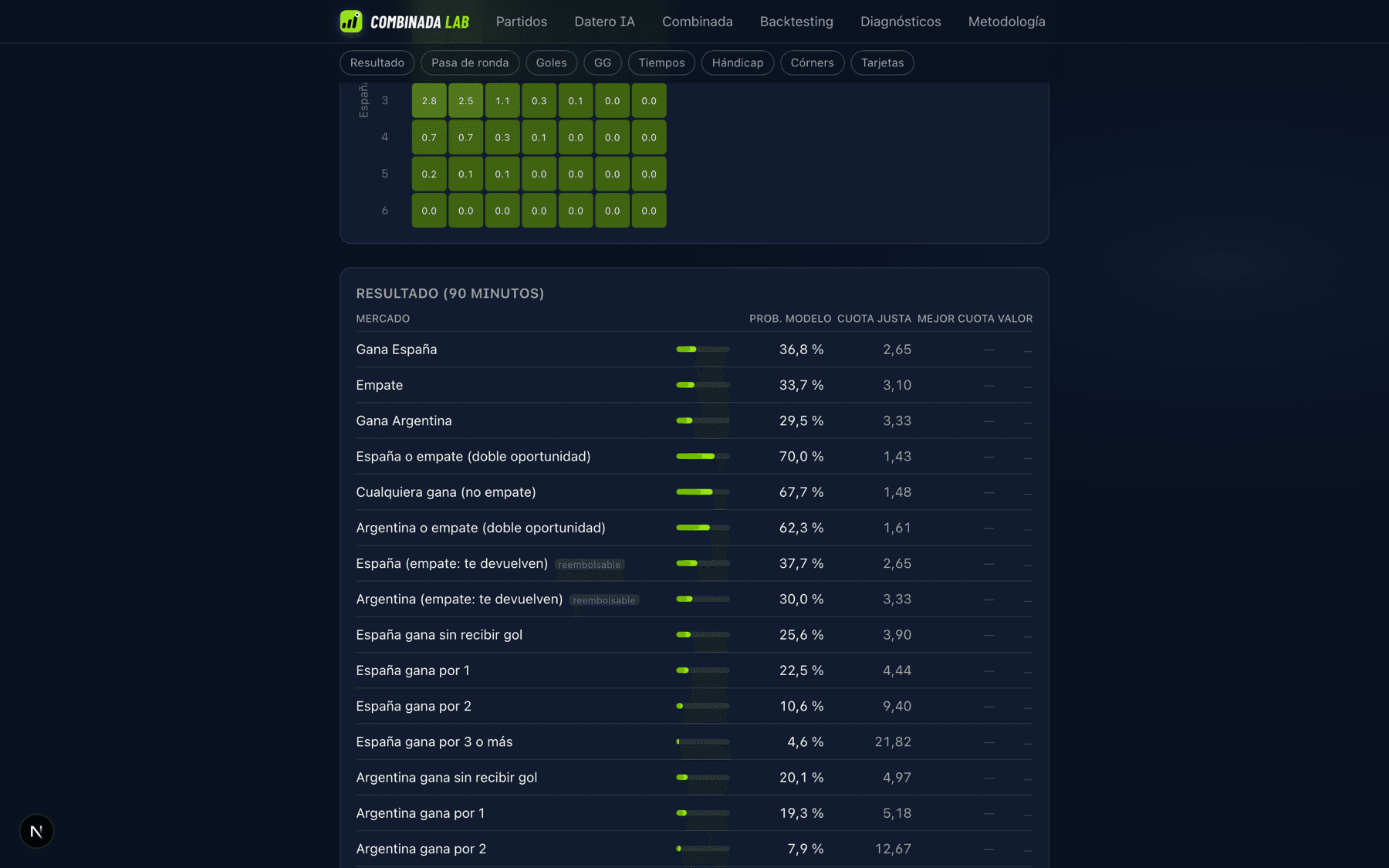
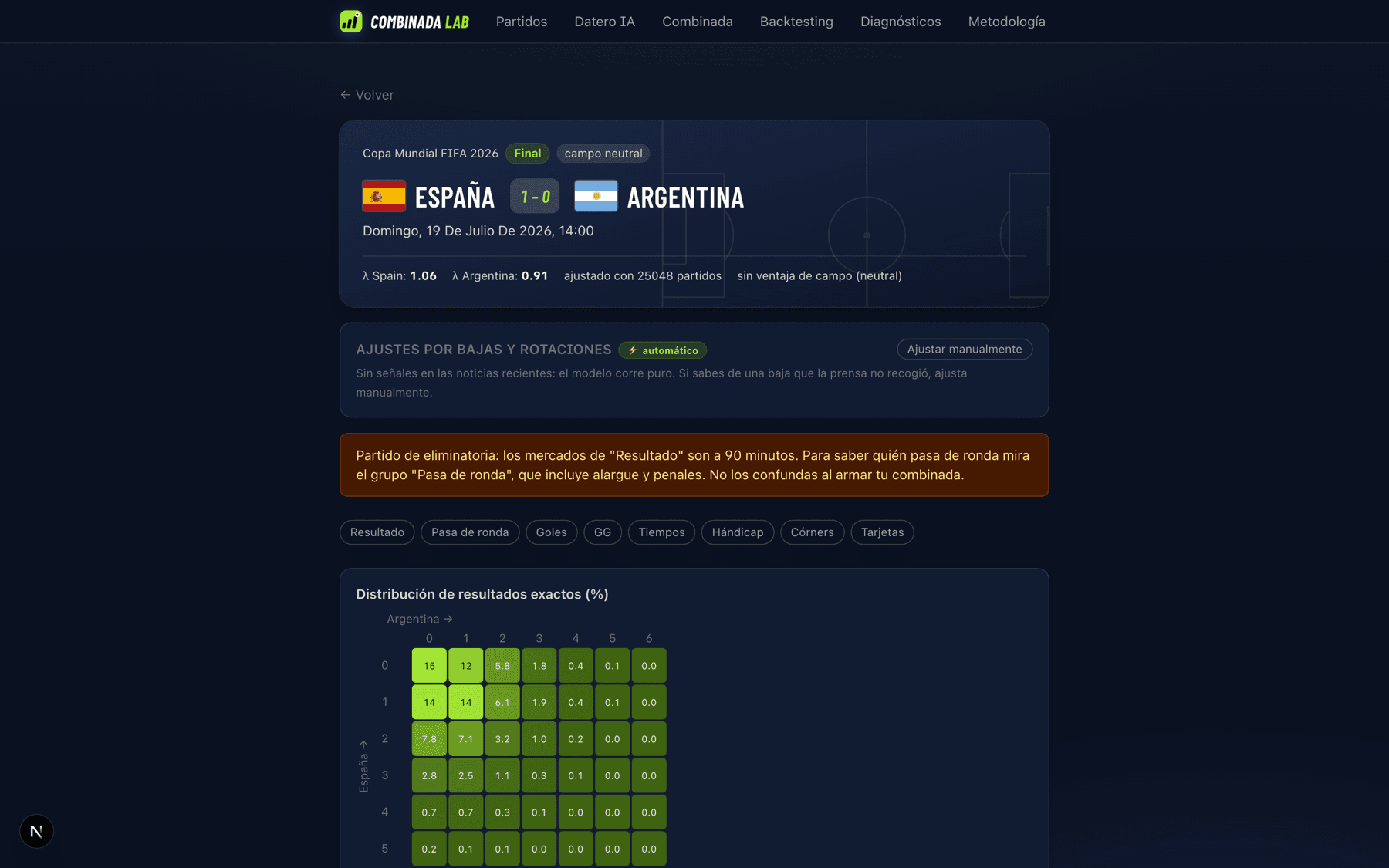
Almost every betting tool multiplies the probabilities of each selection together. That is wrong whenever the selections come from the same match: P(over 2.5 ∧ both teams score) is not P(A)·P(B). Combinada Lab evaluates parlay legs over the model’s joint distribution — a 4D score grid split by halves — so correlated legs are priced correctly instead of optimistically.
Underneath is a Dixon-Coles goal model with time decay, friendlies down-weighted, home advantage applied only at non-neutral venues, and a low-score correction; corners and cards come from a 100k-run Monte Carlo. Bookmaker margin is removed with Shin’s method rather than naive normalisation, because Shin corrects the favourite-longshot bias that makes cheap value look real.
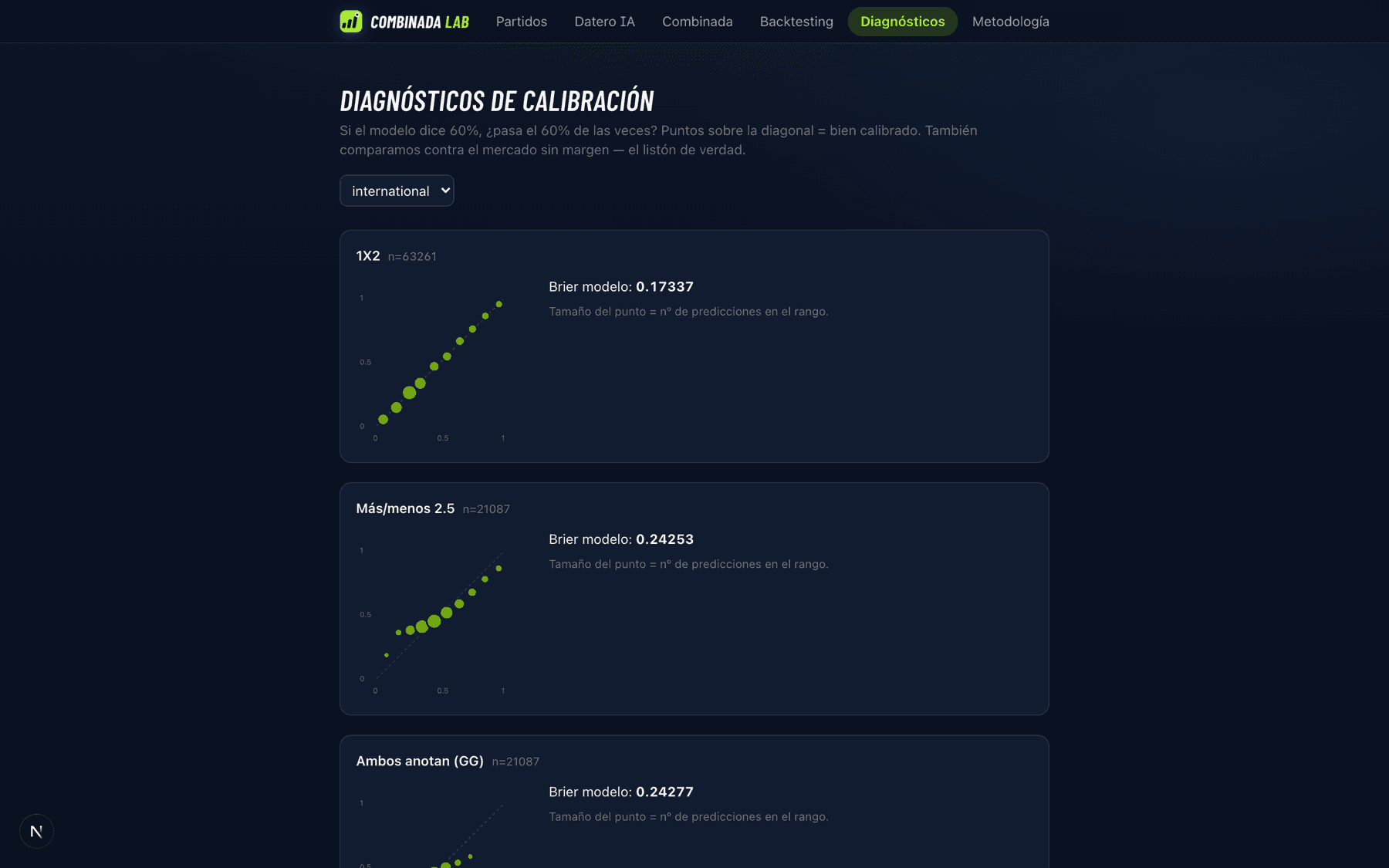
The part I care most about is the backtesting. It is strict walk-forward — at every date the model only knows earlier matches, and there are tests asserting that running a test cannot poison the future or change the past. It reports ROI at flat stake and fractional Kelly against real closing odds, plus a Brier comparison of model versus market. Often the honest answer is that the market is better, and the app says so.
- Dixon-Coles goal model with time decay, neutral-venue handling and low-score correction
- Exact joint probabilities for parlays over a 4D score grid — correlation is computed, never ignored
- Parlay optimiser (2–6 legs) for most-likely or best-EV, pruning contradictions and logical duplicates
- Evaluate your own slip: paste the bookmaker’s same-game price and see it judged against the real joint probability
- Shin’s method for margin removal, median consensus across books, best available price per market
- Strict walk-forward backtesting with isotonic calibration, flat-stake and Kelly ROI, drawdown and Brier vs market
- Corners and cards via 100k Monte Carlo, with low-confidence selections flagged as such